
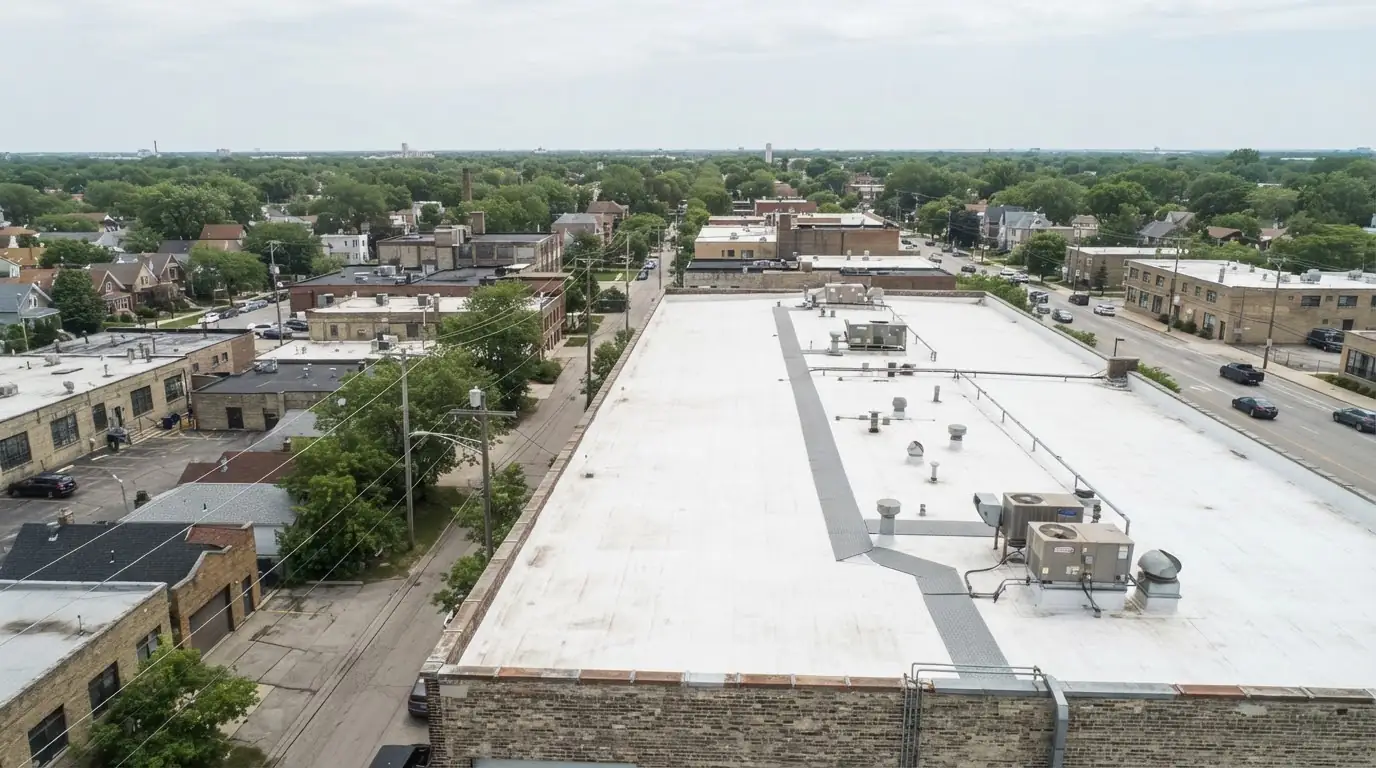
Commercial Roofing for Aurora Retail and Industrial
Retail strips, light industrial and older downtown buildings each fail differently. A survey says which problem you have.
Before you call
- The building type and the roof system, if known
- Where any leaks have been reported
- Whether there are parapets and how much rooftop equipment
- Operating hours and access for the survey
What commercial roofing usually involves in Aurora
Aurora commercial work is anchored by the industrial and logistics property along the rail and highway corridors: large-format low-slope roofs where perimeter uplift, ponding and drain capacity govern service life.
Acres, not squares
At this scale, a maintenance programme is not upkeep. It is the difference between a membrane reaching its rated life and being replaced years early.
Historic downtown at the other extreme
Masonry buildings with parapets and decorative cornices, where the termination detail is essentially the entire job and there is no room to improvise.
Snow drifting against parapets
On large roofs, drifted snow creates concentrated loads and meltwater with nowhere to go if the drains have not been cleared going into winter.
Aurora commercial property
Aurora carries a substantial industrial and logistics base along the rail and highway corridors, plus historic downtown commercial buildings with masonry parapets and large retail concentrations along Route 59 and Orchard Road. Large-format low-slope roofs dominate the industrial side.
More on Aurora
Illinois’ second-largest city, spanning 19th century districts and vast newer subdivisions.
Roofing in Aurora, ILMore on commercial roofing
Full Commercial Roofing details, process and FAQsOther roofing services in Aurora
Related services
Where most people reading this are
Aurora’s commercial roofs range from older masonry buildings downtown to retail strips and light industrial along the corridors. Each type tends to fail in its own way, so the useful starting point is a survey that says which problem your building actually has.
What the roofer does, in order
Identify the roof system
Older downtown buildings often have built-up or modified bitumen roofs behind parapets. Newer retail and industrial buildings are more often single-ply.
Survey and document
Membrane, seams, parapets, coping, drains and penetrations photographed and marked on a plan.
Recommend
Repair, restoration or replacement, ranked and priced so you can plan.
Do the work
Staged around your operations or tenants where needed.
What moves the price
These are what decide the number on the estimate. Ask for each one to be on its own line.
- Building type and roof system
- A masonry building with parapets and a built-up roof is a different job to a single-ply retail roof.
- Parapets and coping
- On older buildings, parapet walls and their coping are frequent leak sources and may need masonry work.
- Drainage
- Scuppers, drains and slope determine whether water leaves the roof.
- Size and access
- Roof area and how materials get up there both move the number.
Commercial Roofing questions from Aurora
Why does our older downtown building leak at the parapet?
Parapet walls take weather on both sides and the top. The coping joints open with freeze-thaw, and water gets into the wall and down behind the roof flashing. The leak often appears well away from the parapet itself. The fix is at the coping and counterflashing, not the field of the roof.
What roof system is best for a retail building?
It depends on the building, budget and how long you plan to own it. Single-ply TPO and EPDM are common on low-slope retail. Modified bitumen is common on older and smaller buildings. A roofer can explain the trade-offs for your specific roof.
Can work happen while the business is open?
Usually, with planning. Crews can stage work around opening hours and keep access clear. Noisy or odorous work may need scheduling. Talk through your operating hours at the survey stage. Torch-applied and adhesive systems carry a smell, so raise tenants or food service below early, because it can change which system makes sense.
How do we know if the insulation under the roof is wet?
Moisture scanning or core samples show it. Wet insulation loses its value and weighs down the deck, and it can hide a leak that is spreading. It is worth checking before deciding between repair and replacement. Cutting out the wet sections early keeps the damage from spreading.
Who should be on the roof during a survey?
The roofer, and ideally whoever manages the building or knows its history: past leaks, earlier repairs, when the roof went on. That background saves time and points the survey at the right areas. If tenants have reported leaks, have their locations marked on a plan before the visit so nothing gets missed.
Need commercial roofing in Aurora?
Say where the property is and what the roof is doing. Coverage runs from Downtown Aurora across Kane County.