
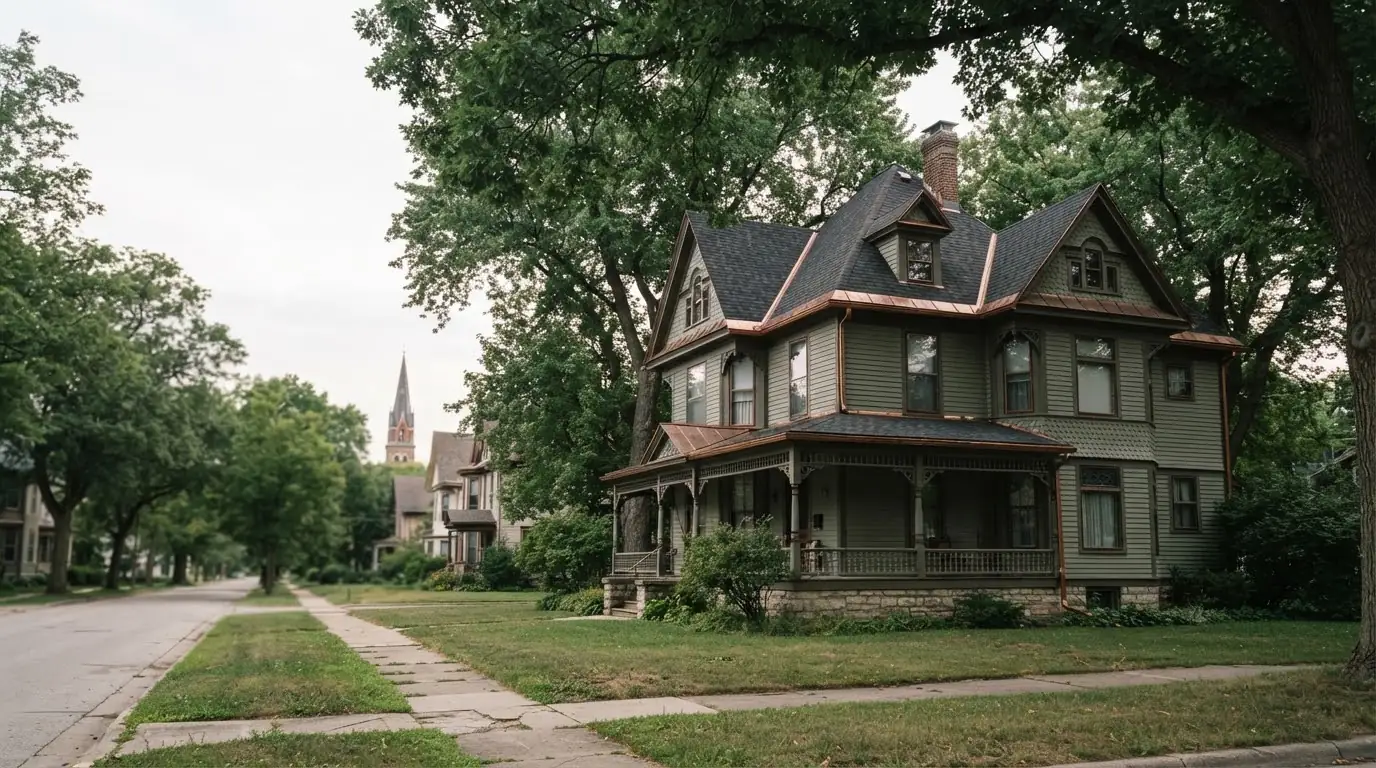
Aurora Roofing for Historic Homes and New Subdivisions
Older homes near downtown and newer subdivision houses leak in different spots. One free inspection finds where yours lets water in.
Older roofs and what keeps them watertight
Aurora is the second-largest city in Illinois and carries a correspondingly wide range of building stock. There are historic districts near the Fox River with 19th century architecture, extensive early- and mid-20th century neighborhoods, a real industrial base, and enormous volumes of subdivision construction on the far east and far west sides built from the 1990s onward. The roofing conversation here depends entirely on which Aurora you are in.
The historic districts near the river carry Victorians, Italianates, Queen Annes and foursquares from the 1870s through the 1920s, with steep pitches, turrets, dormers, extensive valley footage and masonry chimneys where counterflashing has to be cut properly into aging mortar. Some retain original slate. The mid-century neighborhoods add bungalows, ranches and Cape Cods on simpler forms. The far east and far west subdivisions are dominated by 1990s and 2000s two-story homes with multi-gable elevations, projecting garages and vaulted interior volumes. Those newer subdivisions are moving through first replacement now, in phased waves.
What the weather does to an older roof
The Fox Valley sits in an active severe weather corridor with recurring straight-line wind events and periodic damaging hail. Open terrain on the outer subdivisions offers no wind buffering. The river corridor makes drainage more consequential for properties near it, and freeze-thaw cycling is hard on the older masonry and the flashing embedded in it in the historic districts.
What each service runs into in Aurora
Roof Replacement
Replacement scope in Aurora depends entirely on which part of the city the property sits in. Historic-district homes bring steep, elaborate roofs and aging masonry; the outer subdivisions bring 1990s and 2000s elevations reaching first replacement.
Slate is a repair conversation first
Where original slate survives in the districts, replacing it starts a clock that did not need starting. Worth asking whether repair keeps a roof that still has decades in it.
Valley footage on the newer stock
Multi-gable elevations concentrate water. Valley metal and its detailing do more to determine service life on those roofs than the shingle grade does.
Fox Valley wind exposure
The outer subdivisions sit on open ground in an active severe weather corridor, which makes wind rating and nailing-zone placement worth being deliberate about.
Storm Damage Roofing
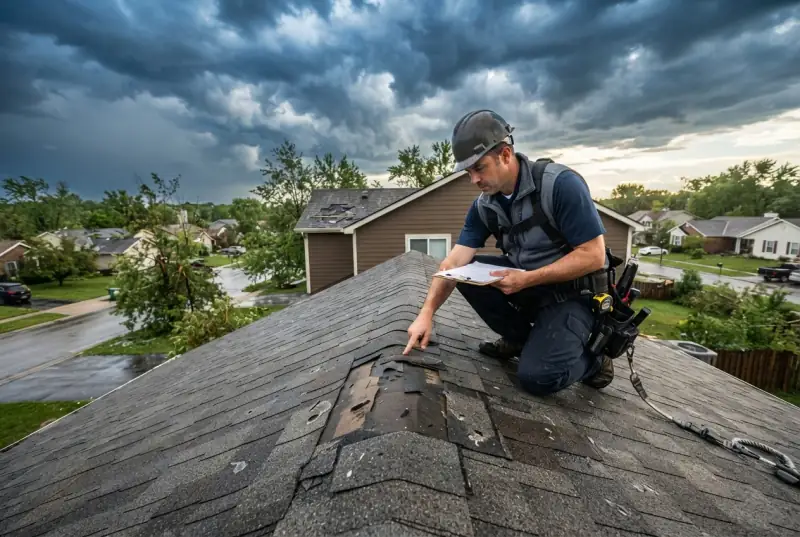
The Fox Valley sits in an active severe weather corridor. In Aurora that means straight-line wind damage across the newer subdivisions on open ground, and a different problem entirely in the historic districts.
Wind works on old masonry
In the districts, high winds stress aging chimneys and the counterflashing set into them as much as the roof surface, so storm damage there is frequently a masonry finding.
Slate displaced rather than broken
Wind and ice can shift individual slates without shattering them. From the ground the roof looks fine, and it is now open at a course.
Subdivision ridge and rake damage
On the outer subdivisions the pattern is conventional and predictable: ridge caps first, rake edges second, and creased shingles that will not reseal third.
Services called in most here
What gets called in most around Near East Side Historic District and Riddle Highlands, roughly in the order it comes up.
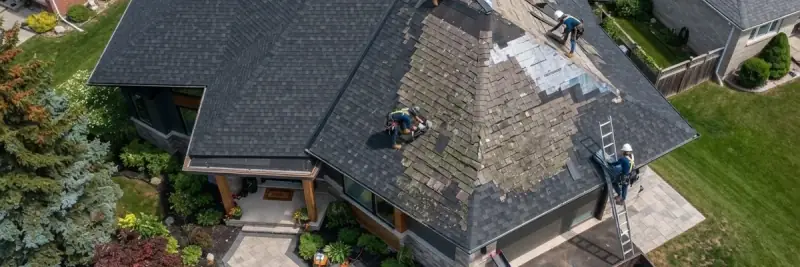
Roof Replacement
Replacement scope in Aurora depends entirely on which part of the city the property sits in.
Learn more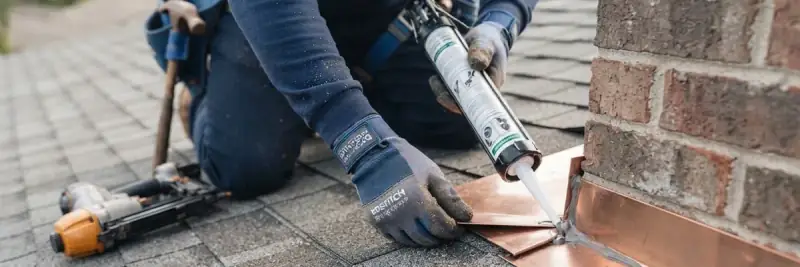
Roof Repair
Aurora repair work spans the full range.
Learn more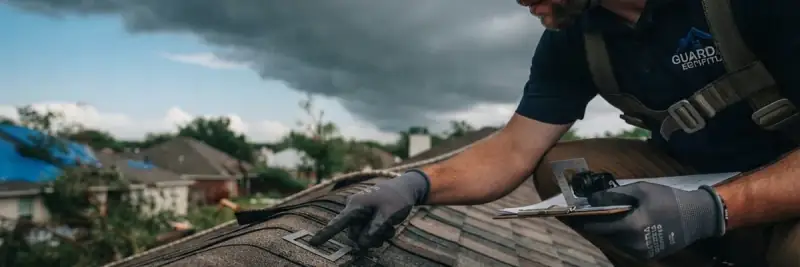
Storm Damage Roofing
The Fox Valley sits in an active severe weather corridor.
Learn more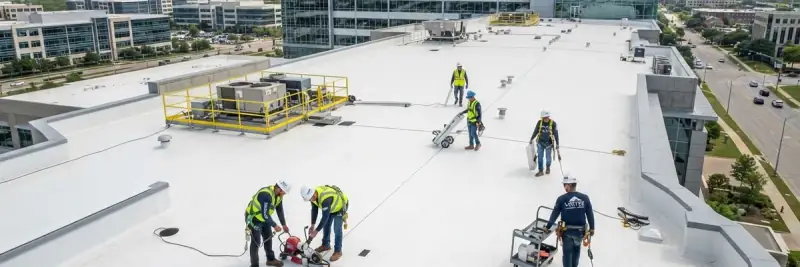
Commercial Roofing
Aurora commercial work is anchored by the industrial and logistics property along the rail and highway corridors: large-format low-slope roofs where perimeter uplift, ponding and drain capacity govern
Learn moreOlder commercial buildings
Aurora carries a substantial industrial and logistics base along the rail and highway corridors, plus historic downtown commercial buildings with masonry parapets and large retail concentrations along Route 59 and Orchard Road. Large-format low-slope roofs dominate the industrial side.
Getting a roofer out
Call with the address and a licensed, insured roofer working Aurora takes it from there: inspection, photographs, then the price in writing. Who does the work.
Roofing questions from Aurora
Specific to Near East Side Historic District, Riddle Highlands and the rest of Kane County, with everything else on the FAQ page.
Does Aurora get more severe weather than other suburbs?
The Fox Valley sits in an active severe weather corridor, with recurring straight-line wind and periodic damaging hail. The open terrain around the newer subdivisions to the east and south leaves those roofs exposed. After a big storm passes through, it is worth a look even when nothing seems wrong inside.
My Italianate has a low roof hidden behind a cornice. How is it roofed?
Many Italianates have a low-slope or nearly flat roof concealed behind a decorative cornice, often with a built-in gutter. That is closer to flat-roof work than shingle work, and the gutter inside the cornice is a common leak point. It needs a roofer who has handled that kind of detail before.
Are the newer subdivisions east of Aurora due for replacement?
Many are getting there. Homes built from the 1980s onward are reaching their first replacement, and the valleys and the attached garage transitions are usually where they show it first. If yours is in that range, an inspection lets you plan the replacement rather than react to a leak.
How do I find out whether my home is in a historic district?
The city’s historic preservation information shows the designated districts, and your property records may note it too. It matters because visible changes to a roof in a district can need review. Find out before choosing materials, so the roof you pick is one that can actually go on.
Nearby communities
Naperville, Batavia, Geneva, Elgin, Plainfield. Each has its own page covering local housing stock.
Get a roof looked at in Aurora
Tell us the address and what the roof is doing. From Near East Side Historic District out to the rest of Kane County, the call takes a minute and the estimate is free.