
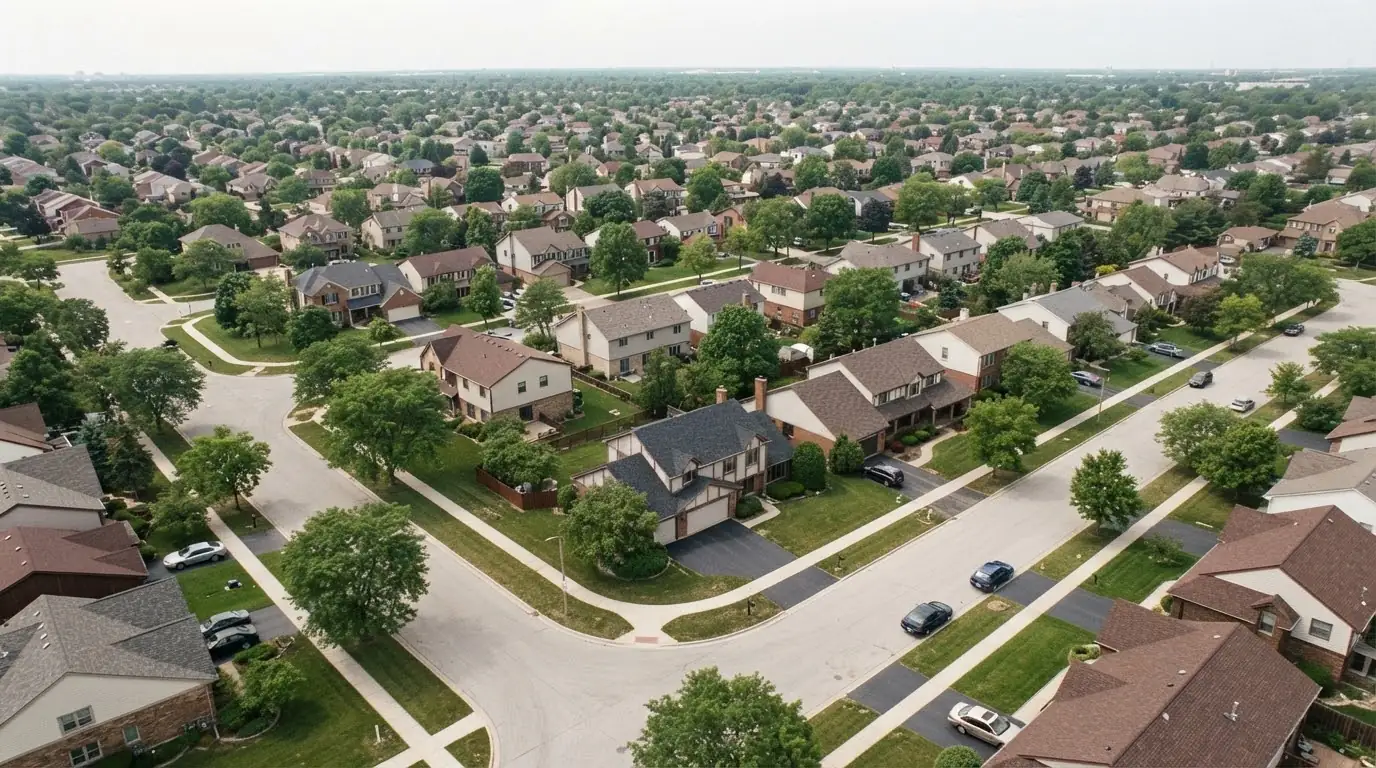
Arlington Heights Roofing, by Construction Era
A pre-war core inside rings of tract housing and later subdivisions. Which ring you are in changes the whole job.
Postwar houses and their weak points
Arlington Heights is one of the larger northwest suburbs and one of the more varied. A pre-war village core sits inside rings of 1950s and 1960s tract housing, which give way to 1970s and 1980s subdivisions, with recent higher-density construction concentrated downtown. For roofing that means the answer to "what should this cost and what turns up on the roof" changes substantially depending on which ring the property sits in.
The postwar rings are dominated by ranches and split-levels on simple roof forms, most now on their second or third shingle roof. The 1970s and 1980s subdivisions brought two-story colonials with steeper pitches, more valleys, and attached garages whose roof-to-wall transitions are a common leak source. Newer construction and teardown rebuilds add complex rooflines with multiple intersecting planes, dormers and roof-mounted features. Downtown density brings townhome and mid-rise properties on low-slope systems. Across all of it, attic ventilation quality varies enormously by era and by who last worked on the house.
Services called in most here
What gets called in most around Arlington Park area and Scarsdale, roughly in the order it comes up.
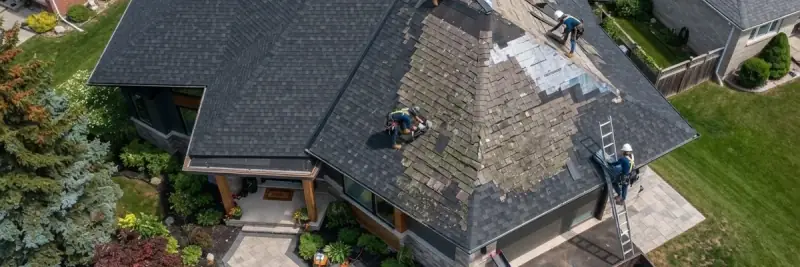
Roof Replacement
Replacements here vary by construction ring.
Learn more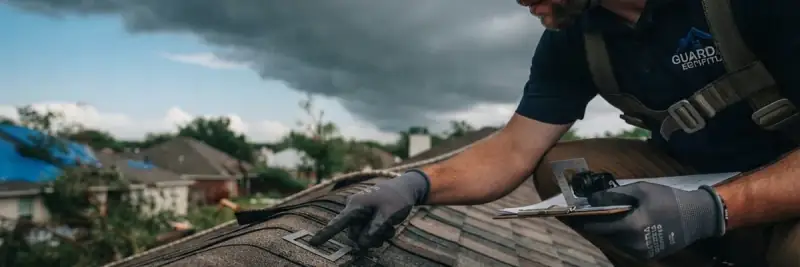
Storm Damage Roofing
This part of the northwest suburbs takes recurring hail, and hail cores are local: one subdivision can be hit hard while the rest of the village is untouched.
Learn more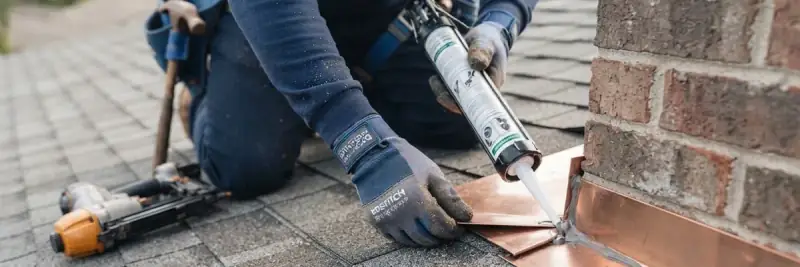
Roof Repair
Repair calls here split by construction ring. In the postwar tracts it is usually a split-level wall transition or a pipe boot that dried out and cracked.
Learn more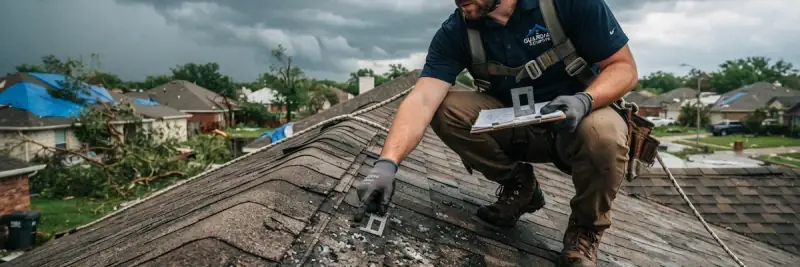
Roof Inspection
Learn moreWhat each service runs into in Arlington Heights
Storm Damage Roofing
This part of the northwest suburbs takes recurring hail, and hail cores are local: one subdivision can be hit hard while the rest of the village is untouched.
Soft metal tells you what fell
Gutters, downspouts, screens and air conditioner fins dent at hail sizes that bruise a roof invisibly. They are useful corroboration and easy to photograph from the ground.
Creased shingles on postwar stock
Wind damage here shows up as lifted and creased shingles that will not reseal rather than obviously missing ones, which is why it gets overlooked.
What is not hail damage
Blistering, foot traffic scuffing and normal aging all get mistaken for it. Genuine hail bruising is random, roughly circular and soft to the touch.
Roof Repair
Repair calls here split by construction ring. In the postwar tracts it is usually a split-level wall transition or a pipe boot that dried out and cracked. In the 1980s and later subdivisions the pattern shifts to valley detailing and step flashing at projecting garages.
Split-level roof-to-wall joints
The intersecting planes on these houses depend entirely on properly woven step flashing, and a large share were originally done with one continuous strip instead.
Downtown low-slope work
The townhome and mid-rise density near the centre means membrane repair, parapet terminations and drainage rather than anything steep-slope.
Hail that only hit one subdivision
Cores through this part of the northwest suburbs are small. It is routine for one neighbourhood to need work while the rest of the village does not.
Weather, and the attic underneath it
Open northwest suburban terrain means real wind exposure: straight-line winds during summer thunderstorm complexes routinely lift ridge caps and rake edges on roofs that are otherwise sound. This part of the metro also sits in an area that takes recurring hail, and a single core can hit a few subdivisions hard while leaving the rest of the village untouched.
Roofing questions from Arlington Heights
Specific to Arlington Park area, Scarsdale and the rest of Cook County, with everything else on the FAQ page.
Why do the ridge caps keep blowing off my roof?
Open northwest suburban terrain gives summer storms a clear run, and straight-line winds lift ridge caps and rake edges first. If they keep going, they were often not fastened or sealed to the manufacturer’s spec. A roofer can refasten them properly or replace them with a high-wind ridge product.
Can an attached garage cause roof leaks?
The garage itself does not, but where its roof meets the wall of the house is a classic leak point on 1970s and 1980s two-story colonials. That roof-to-wall joint lives or dies on its flashing. If you see water near the garage ceiling or the wall it shares with the house, start there.
Will a teardown rebuild next door affect my roof?
Usually not directly, but construction next door can mean debris, dust and sometimes damage to shared fences, gutters or roof edges. If heavy equipment is working close by, have your gutters and roof edge looked at once the work is done, so any damage is caught while the cause is obvious.
What is the difference between three-tab and architectural shingles?
Three-tab shingles are a single flat layer with cutouts and were standard on older roofs. Architectural shingles are thicker and laminated, look more dimensional, and are generally rated for higher wind and a longer life. Most replacements now use architectural shingles. Ask the roofer to show you a sample of each.
Flat roofs on the commercial strips
Downtown mixed-use, the Golf Road and Rand Road retail corridors, and the office properties along Arlington Heights Road provide a steady base of low-slope commercial roofing work.
Getting a roofer out
Call with the address and a licensed, insured roofer working Arlington Heights takes it from there: inspection, photographs, then the price in writing. Who does the work.
Nearby communities
Mount Prospect, Palatine, Buffalo Grove, Des Plaines, Wheeling. Each has its own page covering local housing stock.
From the Roofing Education Center
Need a roofer in Arlington Heights?
Say where the property is and what the roof is doing. Coverage runs across Arlington Heights and the rest of Cook County.