
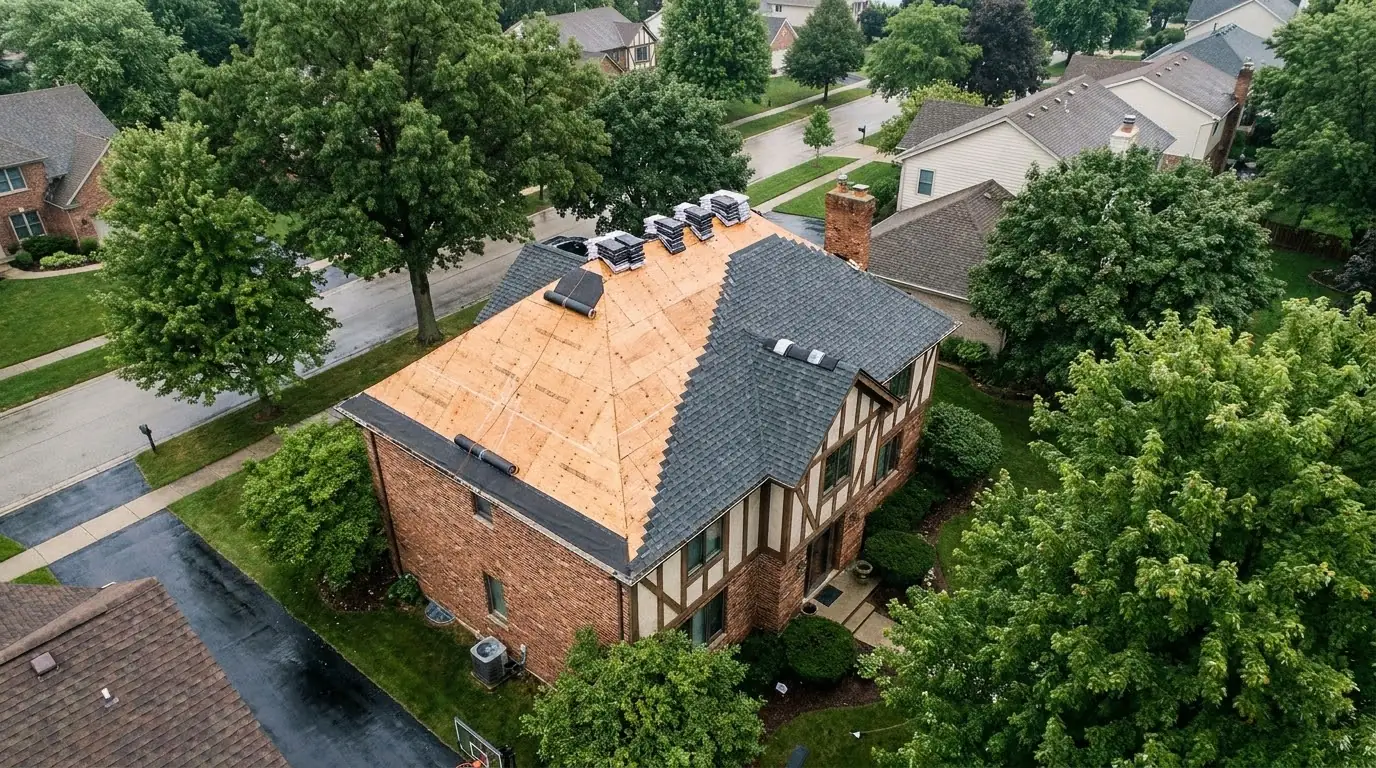
Roof Replacement in Arlington Heights, IL
What a replacement costs here depends on which construction ring the house sits in. The inspection settles it before the quote.
Before you call
- The year the house was built
- Whether the chimney has given any trouble
- Rooms that run hot in summer or show condensation in winter
- How many layers you think are on the roof now
What roof replacement usually involves in Arlington Heights
Replacements here vary by construction ring. Postwar ranches and split-levels are simple in form but frequently carry two shingle layers and inadequate original ventilation, while later subdivisions bring steeper pitches and more valleys.
Two layers is common
On the postwar stock it is worth establishing how many layers are up there before quoting, because it changes both the tear-off effort and what the deck is likely to look like.
New flashing rather than reused
Drip edge, valley metal, step and counterflashing get replaced rather than refitted. Reused flashing is the single most common reason a new roof leaks in its first years.
Hail history worth checking
This part of the northwest suburbs takes recurring hail. A roof coming up for replacement may have damage that predates the decision and is worth documenting first.
More on Arlington Heights
A large, established northwest suburb with several distinct construction eras on the same street grid.
Roofing in Arlington Heights, ILMore on roof replacement
Full Roof Replacement details, process and FAQsWhere most people reading this are
Arlington Heights has a pre-war core inside rings of 1950s and 60s tract housing, with later subdivisions on the outside. A replacement in one ring and a replacement two streets over can be different jobs, so the useful thing to know before you call is roughly when your house was built.
What the roofer does, in order
Work out which roof you have
The roofer looks at the construction era first. An older core house might have plank decking and a steep, cut-up roofline; a 1960s ranch is simpler but often due for ventilation work.
Inspect and photograph
Every slope, the flashing at chimneys and walls, the valleys and the attic, with photos of anything that changes the scope.
Written scope
Each part of the job on its own line, including any ventilation correction and the deck allowance.
Install
Tear-off to the deck, repairs, ice and water shield at eaves and valleys, underlayment, new flashing and shingles.
What moves the price
These are what decide the number on the estimate. Ask for each one to be on its own line.
- Construction era
- Pre-war houses tend to mean steeper pitch, plank decking and more flashing detail. Postwar ranches are simpler to roof but often need ventilation work.
- Chimney and masonry flashing
- Older homes in the core usually have substantial masonry chimneys. Counterflashing cut properly into the mortar costs more than sealant and lasts far longer.
- Ventilation
- A lot of the postwar stock was built with too little intake at the soffits. Correcting it is part of getting the full life out of the new roof.
- Size, pitch and layers
- The basics: how many squares, how steep, and how many old layers come off.
Roof Replacement questions from Arlington Heights
Why does the age of my house change the roof estimate?
Because the roof underneath changes. Older homes often have plank decking, steeper pitches and masonry chimneys that need proper counterflashing. Postwar ranches are simpler but frequently under-ventilated. Same village, very different scope, which is why the inspection comes before the price.
Is a ventilation upgrade worth it on a 1960s ranch?
Usually, yes. Many were built with exhaust vents but too little intake at the soffits, so the attic cooks in summer and condenses in winter. That shortens shingle life and can rot the deck. Getting intake and exhaust balanced is cheap next to a roof that fails early.
Can old plank decking stay?
Often, if it is solid. Plank decking can hold nails well. Gaps between boards may need covering, and any soft or split boards get replaced. The roofer will check it once the shingles are off and should show you anything that needs work.
What is counterflashing and why does it matter on my chimney?
It is the metal cut into the chimney mortar that laps down over the step flashing. It keeps water from running behind the flashing. On older chimneys, a strip of sealant is often doing that job instead, and sealant fails within a few seasons.
How do I find out when my house was built?
Your county property record usually lists the year built, and the Cook County Assessor lets you look it up by address. The paperwork from your purchase often has it too. Knowing the era helps the roofer anticipate the decking, the pitch and the ventilation before they arrive, which makes that first visit far more useful.
Start with an inspection in Arlington Heights
Call and describe the roof. A roofer who already works Downtown Arlington Heights picks it up from there.