
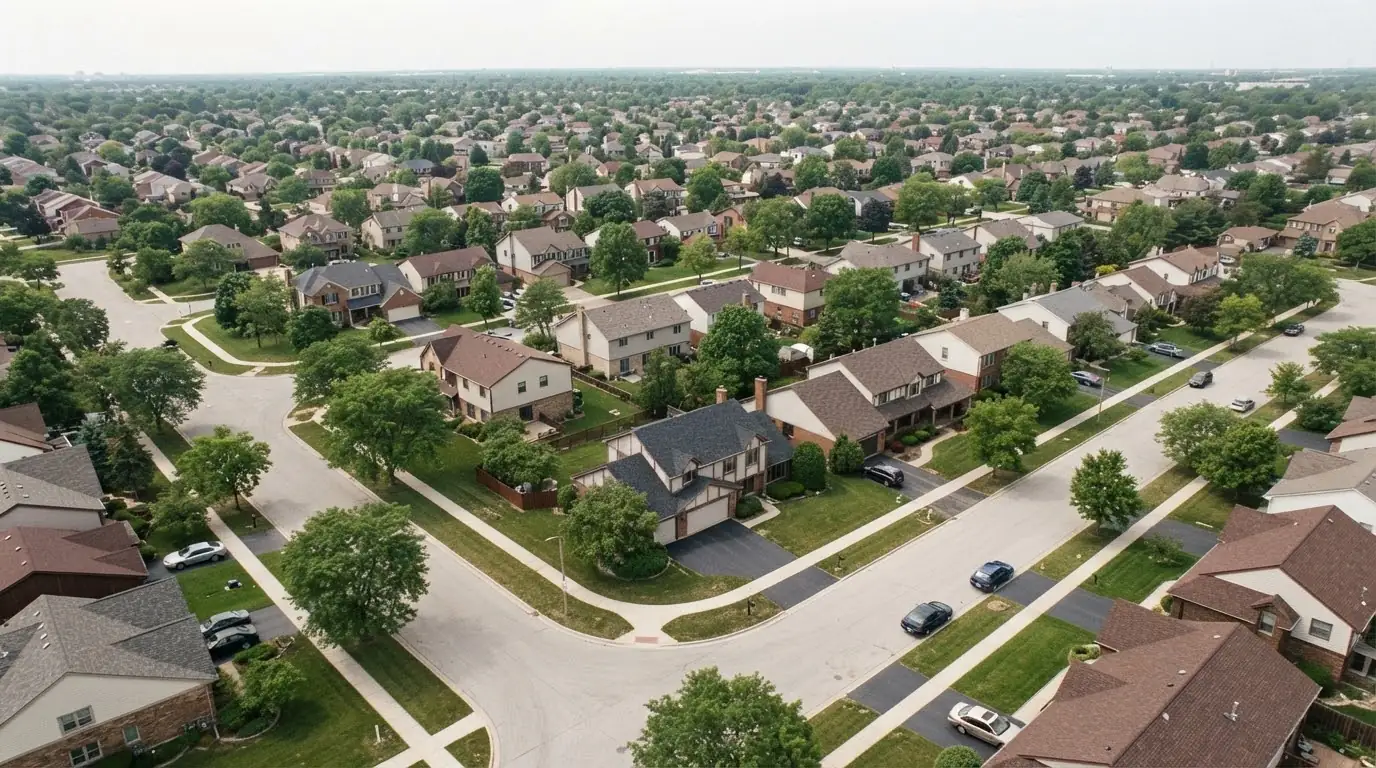
Roofing in Des Plaines, Near the River
River-corridor drainage and open-terrain wind off O’Hare both land on these roofs. Get yours looked at before the next storm.
Postwar houses and their weak points
Des Plaines spans a wide range: a walkable older downtown, large postwar residential tracts, the Des Plaines River corridor running through the middle of it, and a substantial commercial and industrial presence tied to its position next to O’Hare. Each of those brings a different roofing profile, and the river corridor in particular changes how seriously you have to take drainage.
Most of the residential stock is 1950s through 1970s: ranches, split-levels, bi-levels and Georgians. With simple to moderately complex roof forms. The split-levels are where most of the leaks turn up: the intersecting roof planes and the roof-to-wall transitions on those houses depend entirely on correct step flashing, and a great many were done with a continuous strip of metal instead. Older sections near downtown carry pre-war frame and brick homes with steeper pitches. Newer infill and teardown construction has added larger homes with more complex rooflines and more valleys.
Services called in most here
What gets called in most around Cumberland and Riverview, roughly in the order it comes up.
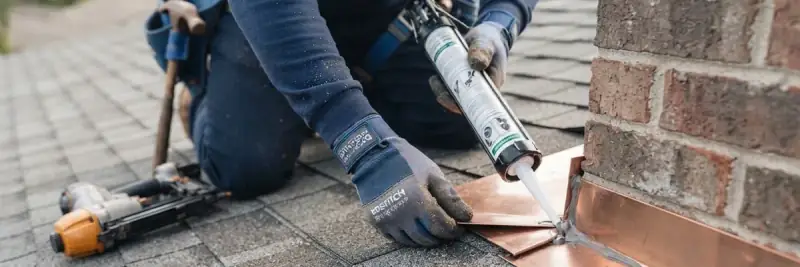
Roof Repair
Split-level roof-to-wall transitions generate a disproportionate share of repair calls here, because a great many were originally detailed with one continuous strip of metal rather than properly woven
Learn more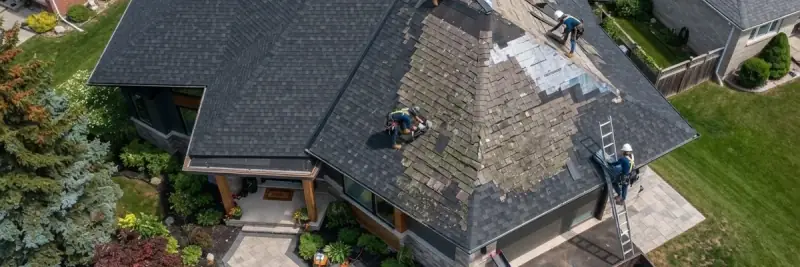
Roof Replacement
Most Des Plaines replacements are on 1950s through 1970s stock: simple roof forms, but frequently with limited original ventilation and, on the split-levels, wall transitions that were never detailed
Learn more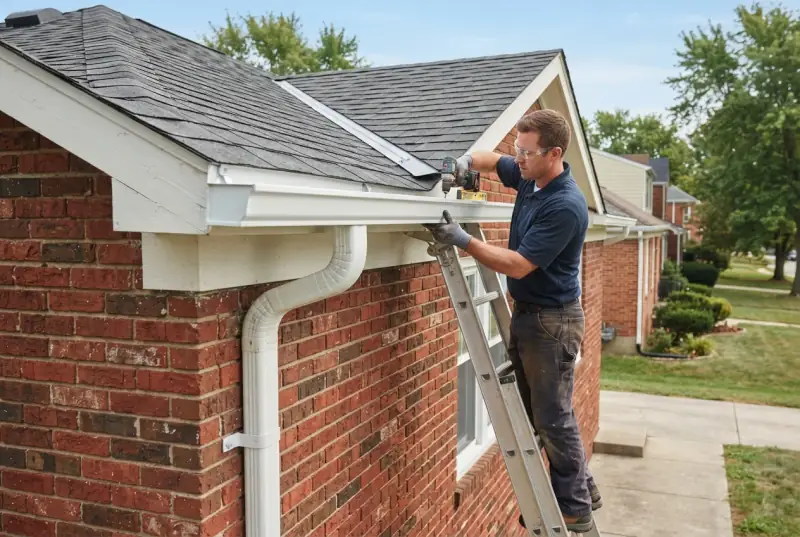
Gutter Services
Learn more
Storm Damage Roofing
Proximity to O’Hare means consistent exposure to open-terrain winds, and Des Plaines storm calls are predominantly wind rather than hail. On the postwar stock, damage concentrates at ridges and rakes.
Learn moreWhat each service runs into in Des Plaines
Roof Replacement
Most Des Plaines replacements are on 1950s through 1970s stock: simple roof forms, but frequently with limited original ventilation and, on the split-levels, wall transitions that were never detailed correctly. Both get fixed during the replacement.
Step flashing rebuilt at the transitions
Where a continuous strip of metal was originally used, the replacement is the opportunity to do it properly with woven step flashing, and it should not be skipped.
Gutter sizing resolved at the same time
For properties near the river corridor, getting drainage right while the edge detail is open is much cheaper than revisiting it as a separate job.
Deck checks on the oldest sections
Housing near the original downtown is pre-war and may carry layers. Sheathing condition is quoted as a contingency rather than assumed.
Storm Damage Roofing
Proximity to O’Hare means consistent exposure to open-terrain winds, and Des Plaines storm calls are predominantly wind rather than hail. On the postwar stock, damage concentrates at ridges and rakes.
Storm plus drainage is two problems
For properties in or near the floodplain, a storm that also overwhelms gutters and downspouts creates a foundation issue alongside the roof one.
Split-level planes catch wind
The intersecting roof planes on these houses create edges in the middle of the roof, not just at the perimeter, and those edges take uplift too.
Commercial exposure near the corridor
The hotel and warehouse property along Higgins and Touhy has large low-slope roofs where wind finds perimeter terminations first.
Weather, and the attic underneath it
Properties in and near the river floodplain need drainage handled properly at every level, roof to gutter to downspout to grade, because saturated soil around a foundation is much less forgiving here. Proximity to O’Hare means consistent exposure to open-terrain winds. The freeze-thaw pattern is standard for the northwest suburbs, with ice damming concentrated on the older, less ventilated stock.
Roofing questions from Des Plaines
Specific to Cumberland, Riverview and the rest of Cook County, with everything else on the FAQ page.
My house is near the Des Plaines River. Does that affect the roof?
Indirectly, yes. Near the floodplain, saturated soil around the foundation is a real concern, so where the roof sends its water matters. Gutters and downspouts need to carry water well away from the house rather than dump it at the foundation. A roofer can check the gutter pitch and the downspout discharge alongside the roof.
How long should a roof last on a 1960s Des Plaines house?
The house will be on its second or third roof by now. A modern architectural shingle roof commonly lasts 20 to 30 years when it is installed and ventilated properly. If yours is around that age and showing wear across whole slopes, an inspection now lets you plan the replacement instead of reacting to it.
What is a bi-level, and does it roof differently from a split-level?
A bi-level has its front door between two floors, with the upper and lower levels offset. It is usually simpler to roof than a split-level, with fewer roof-to-wall joints, but the transitions it does have still need proper flashing. Wherever the roof meets a wall is the place to check first.
Do I need gutter guards?
It depends on your trees. If mature trees hang over the house and the gutters clog every fall, guards can cut down the cleaning. They do not remove maintenance altogether, and a cheap guard can make clogs harder to clear. Ask the roofer which type suits the debris you actually get.
Flat roofs on the commercial strips
The O’Hare-adjacent industrial and hospitality corridor along Higgins and Touhy brings substantial low-slope commercial property: hotels, warehouses and office buildings on membrane systems with heavy rooftop equipment loads.
Getting a roofer out
Call with the address and a licensed, insured roofer working Des Plaines takes it from there: inspection, photographs, then the price in writing. Who does the work.
Nearby communities
Mount Prospect, Park Ridge, Arlington Heights, Niles, Elk Grove Village. Each has its own page covering local housing stock.
From the Roofing Education Center
Talk to a roofer in Des Plaines
Give the address and what you are seeing, and a roofer who already works Cumberland and knows the stock takes it from there.