
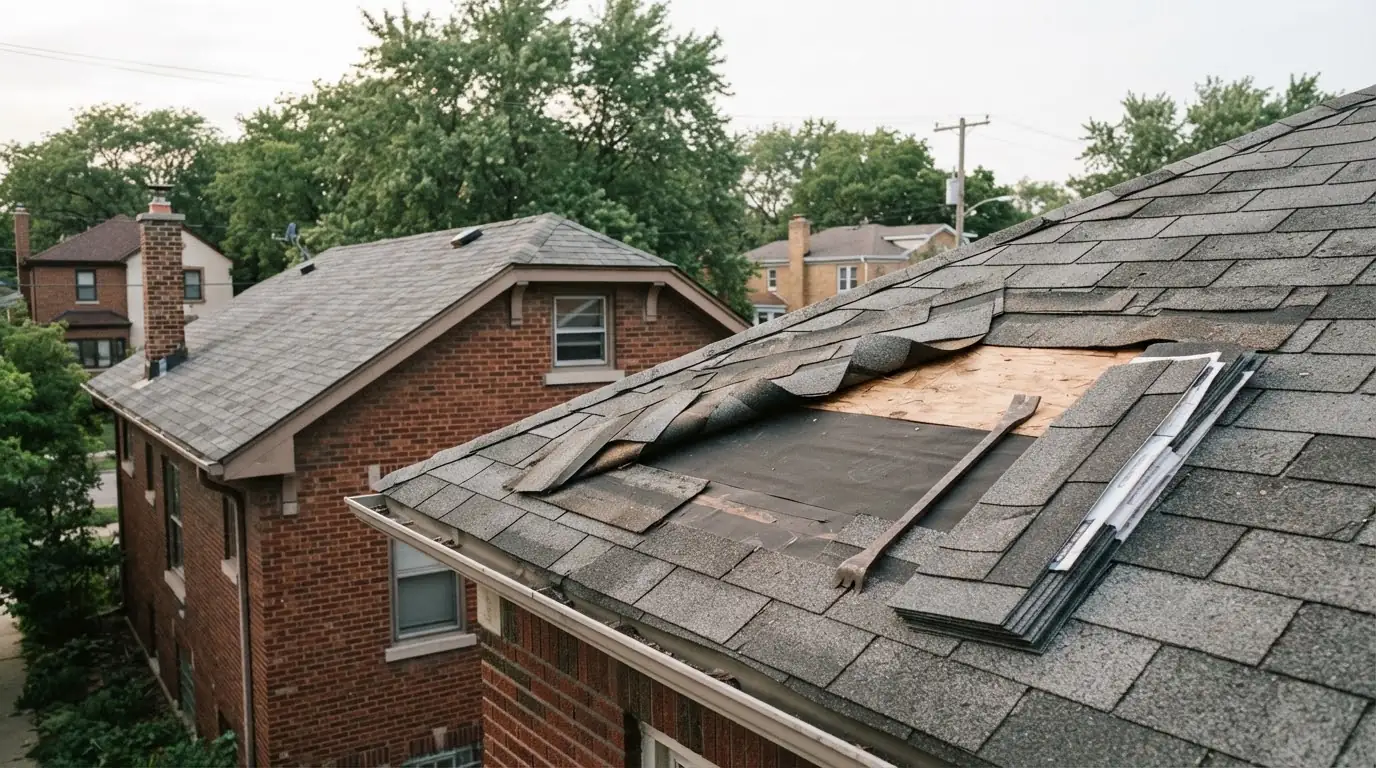
Roof Repair in Des Plaines, IL
Many split-levels here leak where the roof meets the wall. Ask the roofer to check the step flashing before patching shingles.
Before you call
- Whether the water shows on a wall or on a ceiling
- Which part of the house it sits under
- Whether the house is a split-level or bi-level
- When the roof was last replaced
What roof repair usually involves in Des Plaines
Split-level roof-to-wall transitions generate a disproportionate share of repair calls here, because a great many were originally detailed with one continuous strip of metal rather than properly woven step flashing.
Continuous metal where step flashing belongs
It works for a few years and then it does not. Correcting it means opening the courses along the wall and doing it properly, which is more work than a patch but it ends the problem.
River-corridor discharge
Near the floodplain, check gutters and downspout discharge before blaming the roof, because saturated ground around a foundation here is far less forgiving.
Open-terrain wind near O’Hare
There is little shelter in this part of the northwest suburbs, and damage concentrates at the ridges and rakes rather than in the field of the roof.
More on Des Plaines
Postwar residential stock next to O’Hare, with river-corridor drainage complications.
Roofing in Des Plaines, ILMore on roof repair
Full Roof Repair details, process and FAQsWhere most people reading this are
A lot of Des Plaines housing is postwar, with plenty of split-levels and bi-levels where one roof section runs into the wall of another. If your leak shows up near an interior wall, along a ceiling line, or where two parts of the house meet, that wall transition is the first place to look.
What the roofer does, in order
Start at the wall transitions
On split-levels the roofer checks where each lower roof meets the upper wall. That joint depends on step flashing woven in with every shingle course.
Check the flashing method
Proper step flashing is one L-shaped piece per course. A common shortcut is a single continuous strip, which lets water behind it. The roofer will lift a shingle to see which one you have.
Inspect penetrations and valleys
Pipe boots and valleys are the next suspects, especially on older roofs.
Repair the flashing, then the shingles
Fixing the flashing properly means removing shingles along the wall and reinstalling them with new step flashing, not running a bead of sealant along the joint.
What moves the price
These are what decide the number on the estimate. Ask for each one to be on its own line.
- Length of wall transition
- Repairs are priced by how much wall flashing needs to come out and go back in.
- Siding removal
- Proper step flashing sits behind the siding. Getting to it may mean removing and replacing a course of siding.
- Water damage behind the wall
- A long-running leak at a transition can rot the sheathing behind the siding, which adds to the job.
- Roof age
- On an older roof, lifting shingles to reach the flashing can break them. Replacements may be needed.
Roof Repair questions from Des Plaines
What is step flashing and why does it fail on split-levels?
Step flashing is a series of small L-shaped metal pieces, one woven under each shingle course where the roof meets a wall. Each piece sheds water onto the shingle below. When a crew uses one long strip instead, or the pieces rust, water gets behind it and into the wall.
Can the roofer just seal the gap along the wall?
They can, and it will probably stop the leak for a season or two. Sealant cracks with movement and UV, though, and then the leak comes back, often worse. Replacing the step flashing costs more upfront and is the repair that actually lasts.
Why is there water on my wall but not my ceiling?
Because the water is entering at the roof-to-wall joint and running down inside the wall cavity rather than across the ceiling. That points straight at the step flashing on the outside of that wall. Get it looked at before the sheathing behind the siding rots.
Does being near O’Hare affect my roof?
The open terrain around the airport means more exposure to wind than in a dense neighbourhood. Wind lifts shingle edges and breaks the seal strips, especially along rakes and ridges. It is worth a look after strong storms even when nothing seems wrong inside.
Talk to a Des Plaines roofer
Say where the property is and what the roof is doing. Coverage runs from Downtown Des Plaines across Cook County.