
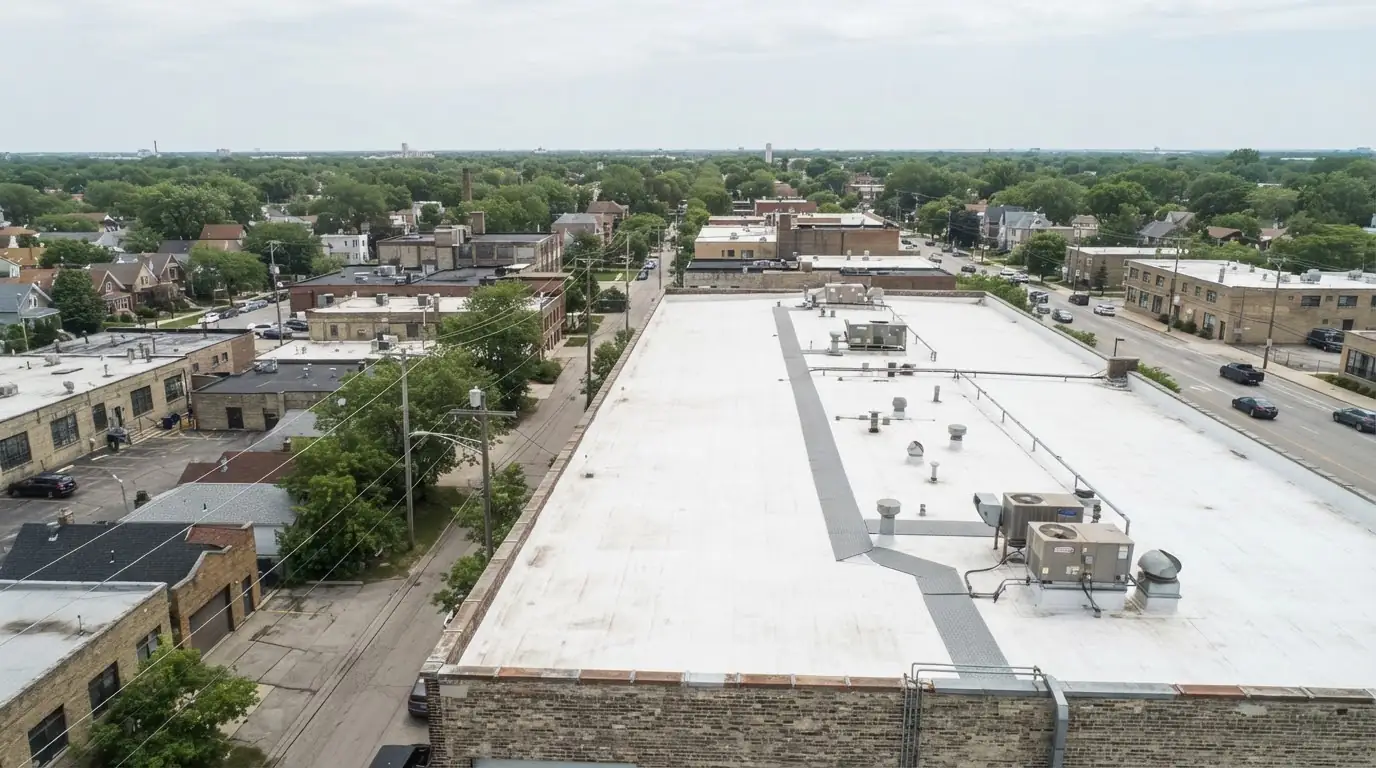
Commercial Roof Repair and Replacement in Joliet
Warehouse roofs measured in acres fail at seams, drains and edges first. Get a licensed roofer to survey yours and document it.
Before you call
- Approximate roof area and the roof system, if you know it
- Where leaks have been reported, marked on a plan if possible
- When the roof was installed and any warranty paperwork
- Access arrangements and operating hours
What commercial roofing usually involves in Joliet
Joliet carries one of the larger industrial and logistics footprints in the region, which means warehouse and distribution roofs measured in acres rather than squares. The historic downtown adds masonry commercial buildings at the other extreme.
Drainage design, not just membrane
Ponding on a large roof is a slope and drainage problem. Repeatedly patching where the water sits treats a symptom while the cause continues.
Interior loss is the real cost
On distribution property, the roof repair is rarely the expensive part. Disrupted operations and damaged inventory are, which is what makes prevention worth budgeting.
Downtown parapets and coping
The historic commercial buildings need masonry-aware detailing where the roof meets the wall, and that work is closer to restoration than to roofing.
Joliet commercial property
The industrial and logistics footprint here is one of the larger ones in the region: warehouses, distribution centres and factories under acres of low-slope roof, alongside older downtown commercial buildings with masonry parapets. Drainage capacity and perimeter terminations drive service life on the large-format roofs.
More on Joliet
A historic industrial city with 19th century housing, limestone architecture and heavy commercial stock.
Roofing in Joliet, ILMore on commercial roofing
Full Commercial Roofing details, process and FAQsWhere most people reading this are
Joliet has a large warehouse and distribution footprint along the interstate corridors, plus older commercial buildings downtown. If you manage a building with a flat roof measured in acres, the problems are seams, drains and edges, and the useful first step is a documented survey you can budget against.
What the roofer does, in order
Roof survey
The roofer walks the roof and documents membrane condition, seams, drains, edges, curbs and penetrations, with photos and a marked-up plan.
Moisture check
On large roofs, wet insulation under the membrane can spread unseen. Moisture scanning, where used, shows which areas are wet.
Prioritise
Repairs ranked by urgency, so you can budget: what needs doing now, what can wait a season, what is end of life.
Repair, restore or replace
Localised repairs, a coating over a sound membrane, or replacement of sections or the whole roof, depending on what the survey found.
What moves the price
These are what decide the number on the estimate. Ask for each one to be on its own line.
- Membrane type and condition
- TPO, EPDM, modified bitumen and built-up roofs each repair differently.
- Wet insulation
- Saturated insulation has to be cut out and replaced. The more of it, the bigger the job.
- Drains and edges
- Failed drains and edge metal are frequent sources of large leaks and of wind damage.
- Rooftop equipment
- Every unit, fan and curb is a penetration. Lots of equipment means lots of flashing detail.
- Access and scheduling
- Working around operations, loading and tenants affects how the job is staged.
Commercial Roofing questions from Joliet
How often should a commercial flat roof be inspected?
Twice a year is the common standard, spring and fall, plus after any major storm. On large roofs with a lot of rooftop equipment or foot traffic, more often. Regular inspections catch failed seams and blocked drains before they turn into wet insulation across a big area.
What is ponding and is it a problem?
Ponding is water that stays on a flat roof long after rain, commonly defined as still standing after about 48 hours. It speeds up membrane ageing, adds weight, and finds any weak seam. It usually points to a drainage or slope issue that is worth correcting.
Can the roof be repaired instead of replaced?
Often, if the membrane is sound and the problems are localised. A survey with moisture scanning shows how much of the roof is wet. If the wet area is small, repair or restoration can make sense. If it is widespread, replacement usually wins over time.
Will a coating extend our roof’s life?
On a membrane that is still sound, with dry insulation underneath, a coating can add years. It is not a fix for a failing roof or wet insulation. Ask for the survey results before anyone recommends a coating. Moisture readings are how you find out which kind of roof you have.
How do we plan the budget for a large roof?
Start with a documented survey that ranks problems by urgency. That gives you a near-term repair list and a realistic view of when replacement will come, so you can plan the capital spend rather than react to leaks. It also gives you a record to show owners or tenants why the money is going where it is.
Get a Joliet roof looked at
Have the address ready when you call. Commercial Roofing around Downtown Joliet starts with someone looking at it.